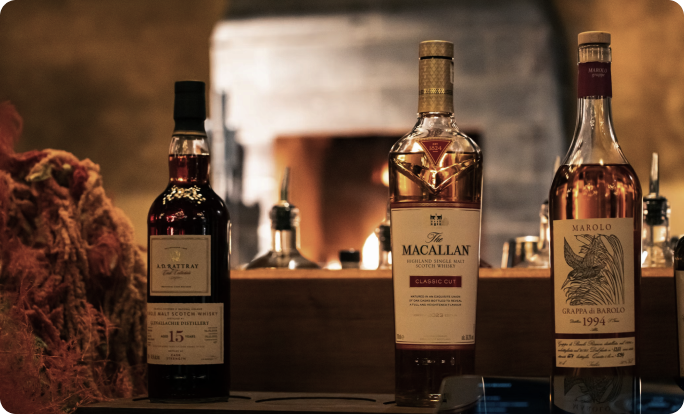
Glenfiddich – 14 Years Old – Rich Oak
70cl / 40%
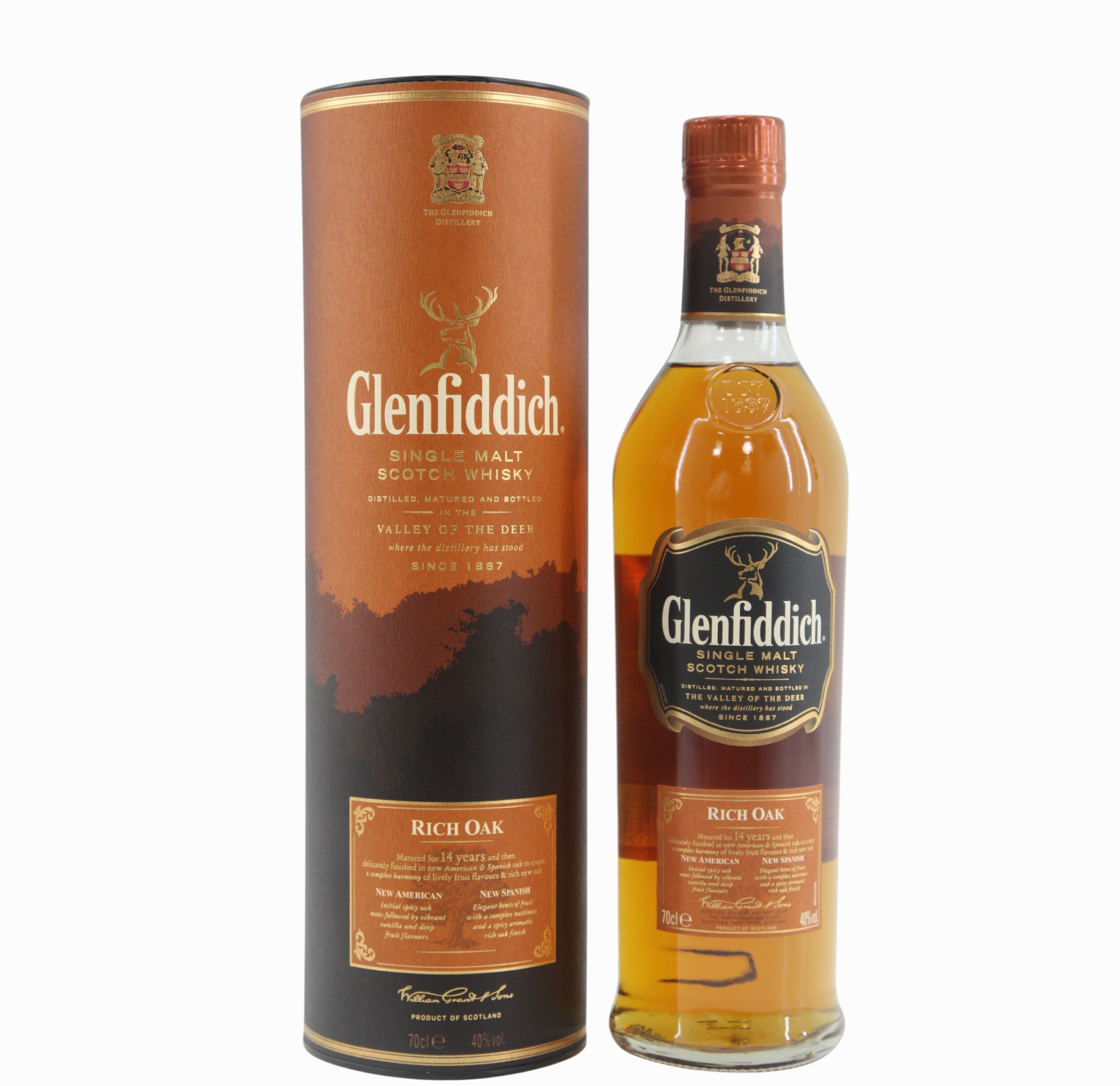
£120.00

- Malt type: Single Malt
- Region: Scotland
If you like this whisky, you will also like these

The Glenfiddich 14 Year Old Rich Oak is classified as a discontinued historical experiment. Its secondary market value stems from its status as a finite artifact, representing a brief era of ambitious, yet ultimately unsuccessful, experimental wood use at the distillery.
Historical Context and Strategic Positioning
The Rich Oak was introduced as part of the distillery’s exploration into maximizing wood impact over a shorter finishing period. It was designed to be a vibrant and complex single malt, focusing heavily on woody spices and ripe summer fruit.
The defining feature was its highly complex cask recipe. Following an initial maturation in American oak casks (ex-bourbon and ex-sherry), the spirit underwent an extra-maturation phase (up to twelve weeks) utilizing a combination of two distinct types of virgin wood: virgin American oak and virgin Spanish/European oak. This dual-virgin oak approach was cited as potentially the first use of such a finishing technique in Scotch whisky.
The expression was discontinued and replaced by the Glenfiddich 14 Year Old Bourbon Barrel Reserve. The successor simplified the cask strategy, moving away from the dual virgin oak approach, and is finished exclusively in charred new American Oak barrels. This simplification suggests the complexity introduced by the Rich Oak was deemed commercially unsustainable or too inconsistent for a core range offering.
Technical Specifications and Cask Regime Analysis
The discontinued Rich Oak (UK/Global iteration) was commonly bottled at 40% ABV. In contrast, the replacement Bourbon Barrel Reserve is often released at a higher 45% ABV in markets like the United States (though a 43% ABV bottling exists globally). This variance suggests an intentional effort to provide greater flavor intensity in the successor.
The preparation of the virgin oak casks was highly specific:
- Virgin American oak casks were typically toasted and charred.
- Virgin Spanish oak casks were only gently toasted and explicitly not charred.
This differing preparation was an attempt to layer complexity: seeking sweet notes (vanilla, toffee) from the American oak and deeper, richer spice notes from the Spanish oak. Official notes cite a "Copper Oak" color, though critical reviews often suggest an "orange-ish tint," strongly implying the use of E150 coloring for consistency, which is standard for the Glenfiddich core range.
| Parameter | Rich Oak (Original, Discontinued) | Bourbon Barrel Reserve (Successor, Current) | Key Difference |
| Age Statement | 14 Years | 14 Years | None |
| Primary Maturation | Ex-Bourbon/Ex-Sherry American Oak | Ex-Bourbon American Oak | Potential Exclusion of Ex-Sherry Base |
| Finish Cask Type | Virgin American & Virgin Spanish Oak | Virgin American Oak (Charred New Oak) | Crucial: Removal of Virgin Spanish Oak |
| Typical ABV | 40% (UK/Global) | 43% (Global) / 45% (US) | Successor often bottled at higher strength |
| RRP (70cl/40% ABV) | ~£48.25 (Pre-Discontinuation) | ~£46.95 (Current) | RRP parity maintained (despite higher ABV in US) |
| Secondary Market Value (70cl) | ~£66.00 Hammer Price | N/A (Current Retail) | Value driven by discontinuation |
Flavor Profile and Critical Reception Discrepancy
Official tasting notes promoted a profile rich with deep vanilla, citrus, caramelized brown sugar, and ripe summer fruits. The palate was described as sweet with layers of creamy toffee, woody spices, and toasted oak.
However, independent critical reception diverged. Reviewers noted the body was "rather weak" with a thin mouthfeel. The major point of contention was the finish, which was frequently described as excessively dry, "tannic," and "astringent." The heavy virgin wood influence led to dominant notes of "Char, lumber, toasted lumber." This suggests a structural imbalance where the Virgin Spanish Oak component, even gently toasted, was the source of the criticized astringency and overwhelming wood influence. The low bottling strength (40% ABV) was insufficient to carry the aggressive flavor compounds, exacerbating the drying effects.